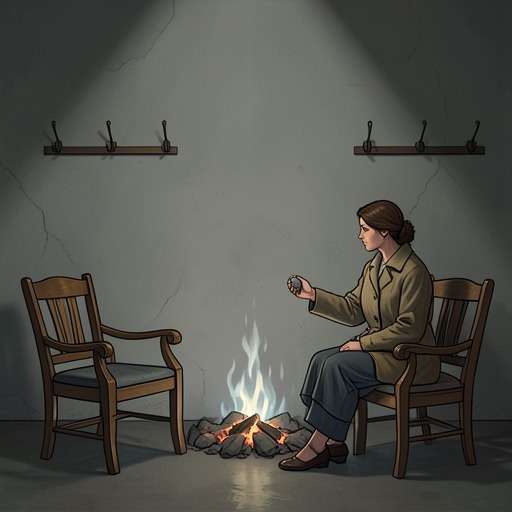
Hana confesses her love to Liesel
The Glass RoomHana confesses her love to Liesel in the Glass Room, transforming an intimate evening of joking and conversation into a moment of disclosure. She tells Liesel that she loves her wholly and sexually; Liesel is startled, but responds with affection rather than rejection. The confession does not establish a love affair. Instead, it makes Hana’s desire unmistakable and leaves the two women negotiating how their friendship can continue with that knowledge between them.
The conversation turns toward desire
The confession grows out of Hana’s account of a film in which Eva Kiesler appears naked. Hana describes the image as a vision of herself as she ought to be, and admits that she may be smitten. She asks whether Liesel could ever love another woman wholly and sexually. Liesel calls that kind of love awful, but Hana challenges the assumption behind her response: a woman might recognize herself in another woman’s beauty in a way that is not reducible to a man’s desire for her.
When Liesel suggests that Hana sounds as if she is speaking from experience, Hana confirms that she is. Liesel wonders aloud whether Hana has fallen in love with Eva Mandl. Hana says that Eva is not the person she loves, though she allows that loving her might not be difficult. The exchange has moved from an abstract question about women’s desire to a personal disclosure whose object Liesel has not yet named.
The declaration in the Glass Room
Before answering, Hana asks Liesel to promise that the truth will not make her hate her. Liesel assures her that she could never hate her. Hana hesitates, drawing on her cigarette; her hand is not quite steady, and her expression is not quite amused. Then she tells Liesel that it is Liesel she loves.
The room’s silence gives the declaration its force. There is no sound from the garden beyond the velvet curtains and no stirring in the building; cigarette smoke hangs above Hana as she asks whether the news shocks Liesel and reminds her not to withdraw her promise. The Glass Room, described as a space of transparency, seems to make the women themselves newly legible. Its atmosphere does not erase the risk of speaking, but it frames Hana’s disclosure as something that can no longer be hidden behind teasing or speculation.
Liesel’s response and the friendship’s terms
Liesel searches for words and says she did not expect such responsibility all at once. She does not claim to share Hana’s desire, and she is concerned that she might hurt her. Hana answers that Liesel will hurt her only if she sends her away. She proposes that the relationship need not become sexual: women can remain friends without becoming lovers. Her response both names the possibility of pain and tries to prevent the confession from making continued closeness impossible.
Hana apologizes for having spoken, but Liesel reassures her rather than asking her to take the words back. The exchange therefore produces no reciprocal romantic commitment. Its immediate outcome is a new, more explicit understanding: Liesel knows what Hana feels, Hana has risked telling her, and both women acknowledge that their friendship may continue without becoming a sexual relationship.
After the confession
Hana gets up and puts on another record she has brought from Paris. A clarinet accompanies a woman singing J’ai deux amours. The music marks a change in the conversation: the laughter and acting recede, and the women speak more quietly about love, friendship, men, Oskar, and Viktor. Liesel watches Hana with what feels like new eyes, recognizing that the person’s outward form is unchanged while the meaning she gives that person has altered. The word completeness comes to Liesel, accompanied by guilt.
When the record ends, Hana asks Liesel to play something for her. Liesel says she is not good enough after drinking and makes mistakes. The request returns the scene to their familiar companionship, but it comes after the confession has changed how Liesel sees Hana. The episode closes not with a decision about romance but with music, conversation, and the continuation of a friendship now made more vulnerable by what has been said.